Campaign
Regulating Autonomous Vehicles
Corporations have lobbied to bring robotaxis to New York City. While the jury’s still out on whether they would be a net benefit to our city, if they come, we need to be sure they’re well regulated.
Autonomous for-hire vehicles, better known as robotaxis, are already operating in cities across the country. Legislation in Albany would legalize driverless vehicles statewide and allow New York City to set its own rules.
We’ve seen this before. The big robotaxi companies are running a similar playbook to the one rideshare apps used 15 years ago; we’re still dealing with the impacts of that rushed, haphazard process, and still struggling to update our regulations to manage the street and curb.
We can’t make the same mistake twice.
Our Research
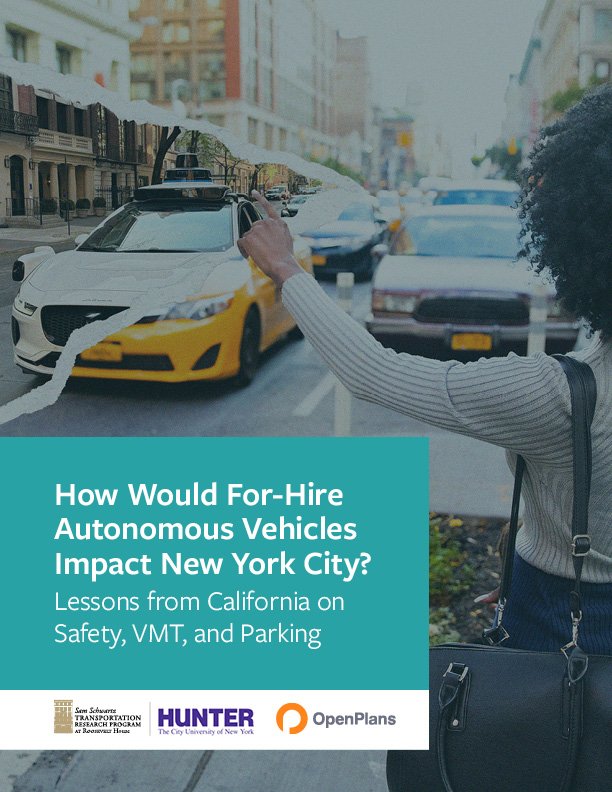
Open Plans partnered with Hunter College to compare our city’s existing for-hire fleet to the largest existing robotaxi fleet, Waymo. This research begins to answer a core, underexplored question: how would robotaxis actually impact New York City?
Our findings showed that while initial safety data is promising, replacing a for-hire vehicle with a robotaxi in NYC could increase vehicle miles traveled and congestion.
As of July 2026, robotaxis in California drove about 15% more empty miles per passenger mile than NYC’s Uber and Lyft fleets. Additionally, NYC’s constrained curb space presents an existential problem for robotaxi deployment. In California, Waymo vehicles spend more than half their time waiting for a ride parked; the situation at the curb in NYC is much more complex.
Taking Action
This isn’t about stopping new technologies; it’s about figuring out what’s right for New York City’s streets. If robotaxis can prove to be a net benefit to our streets, the City must make sure they’re properly regulated before they cause disruptions, not after. Otherwise, our communities will be left scrambling to clean up the mess.
That means responsibly planning for how our roadways will function for all New Yorkers, and not giving in to pressure from corporations and their lobbyists.
Smart robotaxi regulation would:
Make robotaxi companies benchmark their safety data against professional for-hire drivers before they can be licensed.
Require data transparency so critical analyses can be done, with all data available to the public.
Evaluate fees that capture and reduce robotaxis’ impact on streets.
Consider limiting robotaxis in dense, transit-rich commercial areas.
Manage licensing and control deployment to prevent excessive robotaxi VMT growth.
Expand for-hire vehicle pick-up and drop-off zones.
Stop centering single-use vehicles, and look at how automated public transit can fill gaps in the transit system.
The decisions being made on AVs right now will shape New York City’s streets for decades. We need to make sure we get it right.
Stay in the loop about our campaign to regulate autonomous vehicles in NYC
Sign-up for our biweekly newsletter
TAKE ACTION
Stay in the loop about our campaign to regulate autonomous vehicles in New York City.
More on Urban Mobility